
PAUSD Has $35K Per Student — A Number Most Districts Would Kill For. Why Doesn’t It Feel Like It?
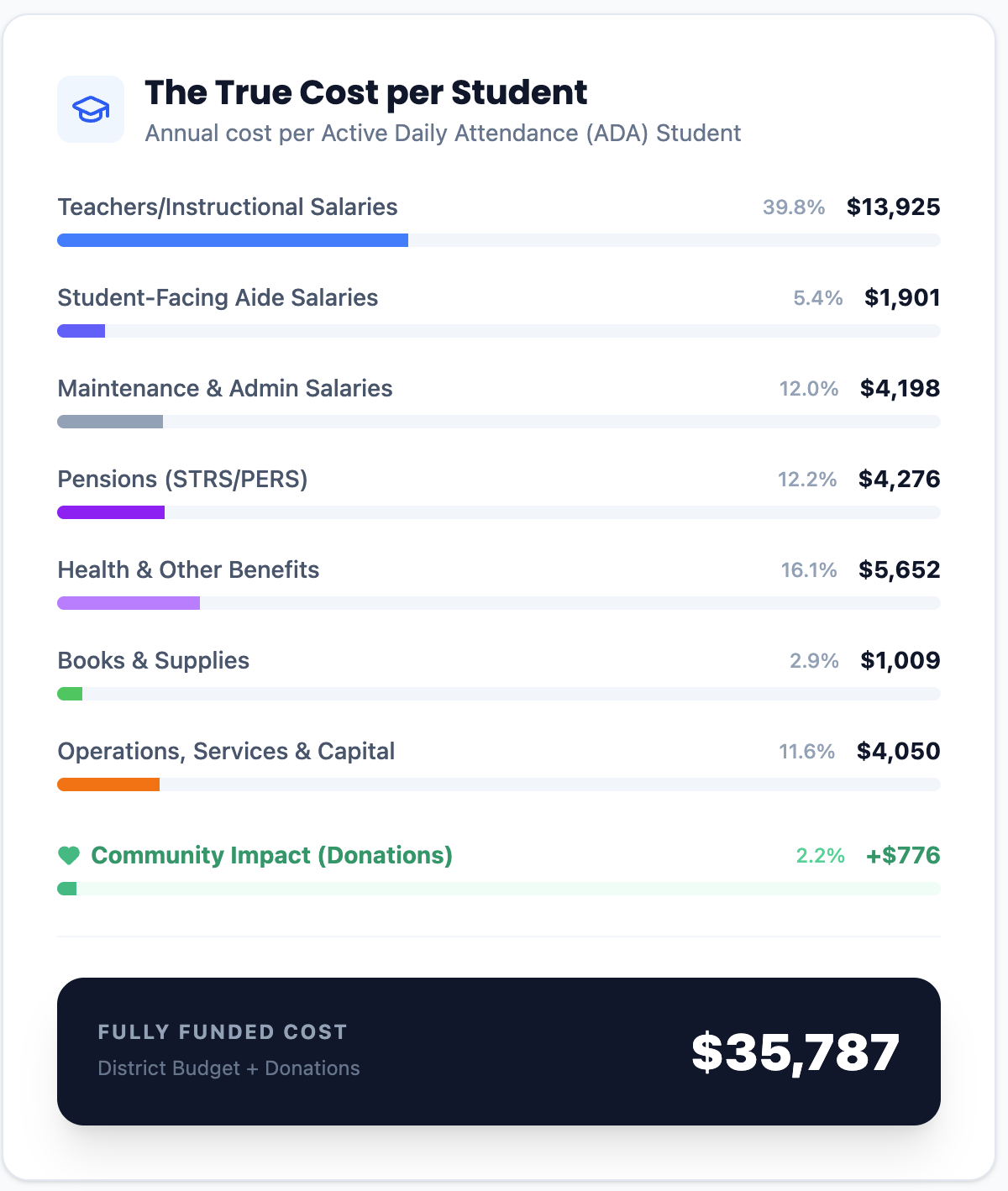
Most school districts in America would do backflips for $35,000 per student. Palo Alto gets that — and then some. In comparison, Los Altos spends about $28K, San Jose around $18K, and the national average is about $18K. A decade ago, PAUSD was at roughly $18K — about $23K adjusted for inflation.
Yet every budget cycle brings the same story: projected shortfalls, threats of teacher layoffs, and heated board meetings… and calls for yet another parcel tax increase.
How can a district spending nearly double the national average still feel chronically broke? I looked at the data, and also built PAUSD Budget Explorer to understand where the money goes.
From the latest budget (2024–25):
- Total operating budget: $340 million
- Enrollment: ~10,200 students
- Per-student spending: up from ~$18K just a decade ago
- National average: ~$18K (Statista/NCES)
At the same time:
- Enrollment has dropped from 12,261 to 10,209 students
- Staff full-time equivalents have risen from 1,300 to 1,384
Why the Extra Money Per Student Isn’t Translating to Better Schools?
PAUSD doesn’t get paid by student count, it gets paid by property taxes. So when enrollment falls, there is more money available per student. Hypothetically, this should be a gift: smaller classes, more support staff per child, richer programs.
I pulled NCES federal data for PAUSD from 2014 and 2024. Here’s what a decade looks like:
Classroom teachers dropped from 681 to 597 — a loss of 84 teaching positions, even as per-student funding nearly doubled. Meanwhile, total staff grew from roughly 1,256 to 1,385 — an increase of about 128 positions. That means the district cut 84 teachers and added over 200 non-teaching positions.
Where did the growth go?
- Instructional aides: 194 → 247 (+53)
- School administrators: 27 → 35 (+8)
- School admin support staff: 51 → 71 (+20)
- Other support services: 175 → 293 (+118)
- School psychologists: not separately tracked in 2014, now 19.4 FTE
The “other support services” bucket — up 118 FTE — is doing most of the work and is the least transparent category. This is likely where special education aides, wellness staff, tech support, and facilities positions live.
Some of this growth is real and necessary. Special education mandates have expanded, and mental health support positions were added in response to well-documented student crises in Palo Alto. But the net picture is clear: the money went to support and admin staff, not to teachers in classrooms.
The cost of each employee has also gone up - about 86% of the budget goes to salaries and benefits — but a growing share of that is mandated pension contributions (the CalSTRS employer rate went from 8.25% to 19.10% over the past decade — more than doubling) and healthcare cost increases. These aren’t spending choices anyone in Palo Alto made. They’re structural costs that silently eat the gains before a single dollar reaches a student.
The recent conflict makes more sense through this lens. When Superintendent Don Austin proposed cutting 18 positions, it was met with fierce resistance — and he ultimately departed. The teachers’ union is requesting what the district characterizes as a 28% total compensation increase. Both sides have legitimate arguments — teachers can barely afford to live here, and the district can’t absorb $42.5M in new ongoing costs. But the deeper issue is that both are fighting over a pie that’s being consumed by forces neither controls.
Palo Alto Taxpayers (not the federal or state government) pays for all of this (and more)
Palo Alto is a “basic aid” district, meaning our funding comes almost entirely from local property taxes, the voter-approved parcel tax, and occasional bond measures — all of which have continued to grow even as enrollment shrinks.
The budget conversation usually focuses on the $340M operating budget. But Palo Alto taxpayers are also funding ~$55M a year in bond debt service for construction, plus $16.5M in parcel taxes. Yes, bonds are legally restricted to facilities — the district can’t redirect that money to salaries. But from the taxpayer’s perspective, it all comes from the same pocket. When we approve a bond measure and a parcel tax and pay rising property taxes, the total ask keeps growing. It’s worth looking at the full bill, not just one line item.
This also brings up the upcoming June 2026 Parcel Tax renewal - do taxpayers really need a $16M parcel tax alongside our $340M total budget (plus $55M construction bonds)?
The question PAUSD needs to answer is what the right staffing mix looks…
- What is the “right” FTE mix for PAUSD? Should we hire more teachers and reduce support staff? How will the incremental FTE hiring improve the quality of education for our children?
You can see the full interactive budget breakdown yourself in the PAUSD Budget Explorer