This was a famous prediction from 2016 by Geoffrey Hinton that hasn’t materialized.
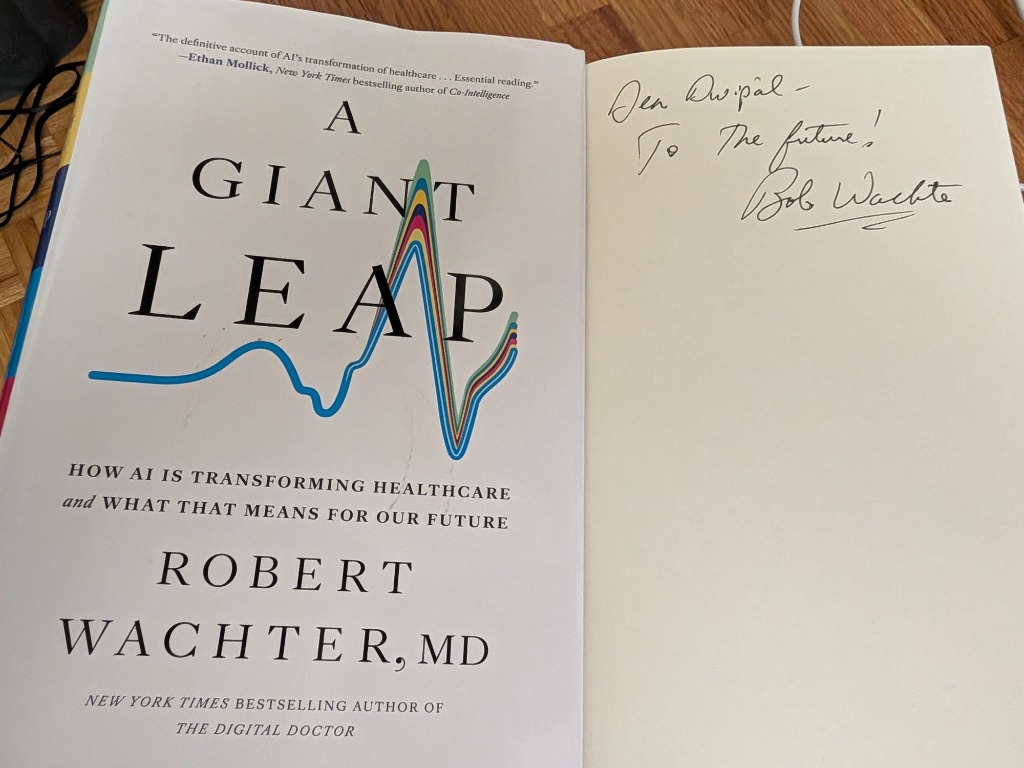
I recently read A Giant Leap by Robert Wachter, MD (a great book on AI and healthcare, thanks Bob for the signed copy!) and he gives a clear explanation.
A radiologist doesn’t just look at an X-ray in isolation. The gap becomes obvious when you look at everything a radiologist actually does, and what it takes for AI to do the same:
- The patient’s clinical history alongside the image
- Prior scans and reports, often spanning years
- Models that look across many conditions, not just one
- Enough labeled data to train on all of the above
- A tool that fits into the radiologist’s workflow, with its data collection and back-and-forth with clinicians
- FDA approval - radiology software is a medical device (SaMD), so each use case needs its own
None of these is a technical limitation; each is possible today. In practice, though, data is scattered across systems and years, labeling is slow and expensive, workflows are messy, and every new condition means another round of approval. Until we solve the whole thing e2e, we’ll keep getting narrow tools that help radiologists (e.g., improving breast cancer detection by ~20%) but don’t replace them.
I think about this whenever I hear “AI will replace X” predictions today. Just because AI can do the core task (write code, read a scan) doesn’t mean the job goes away - the hard part is everything else around it.